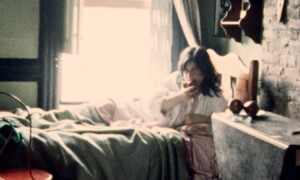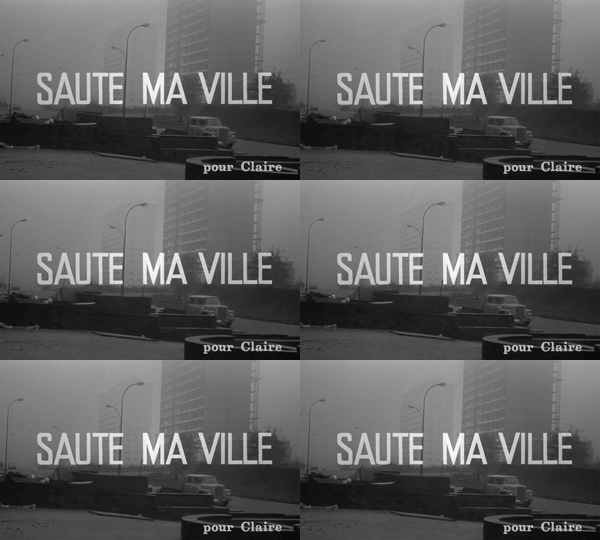
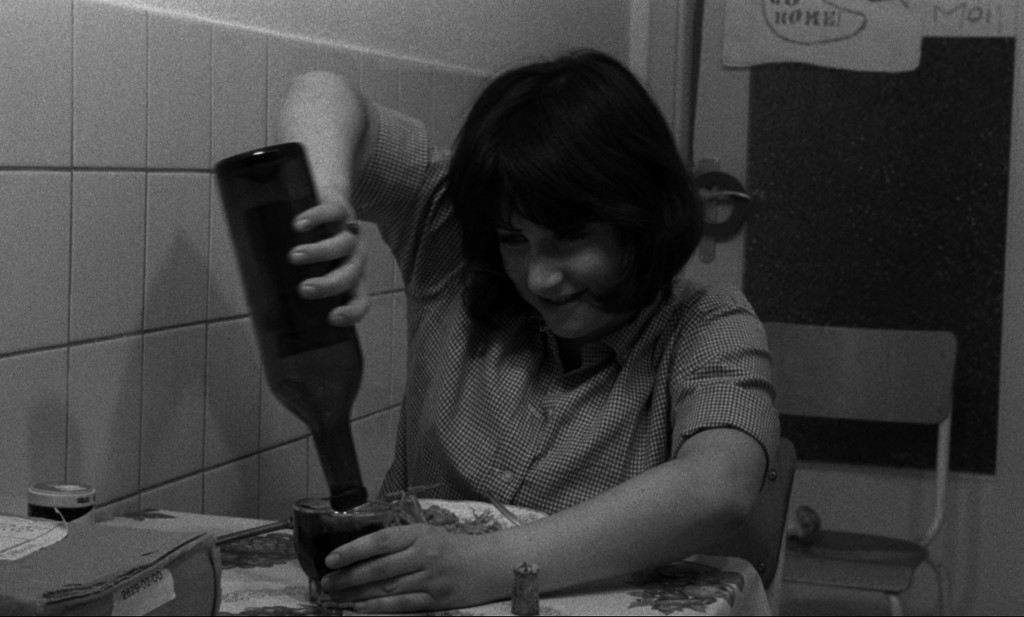

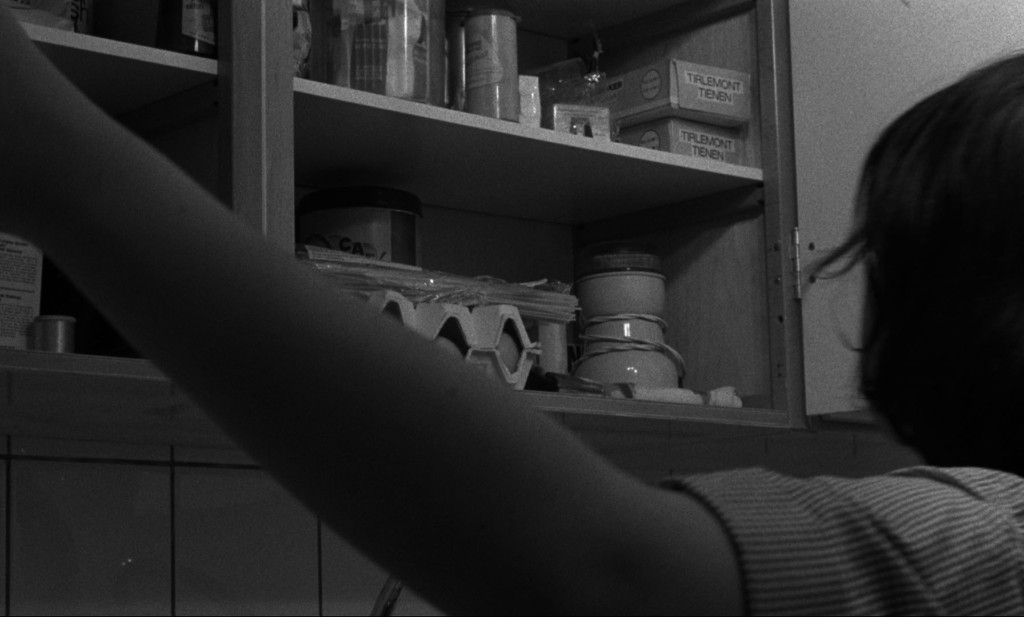
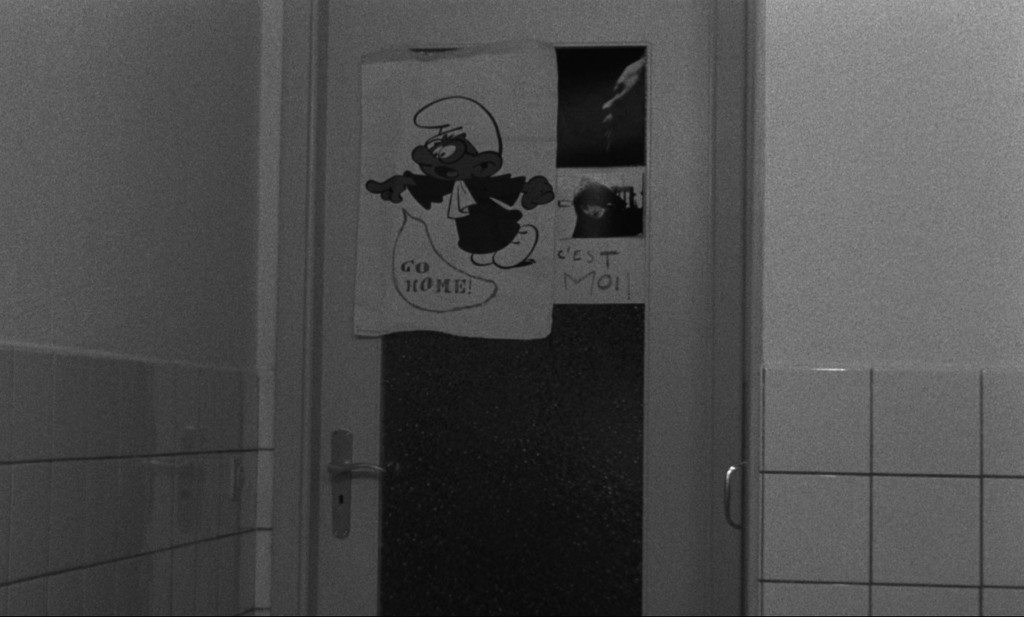
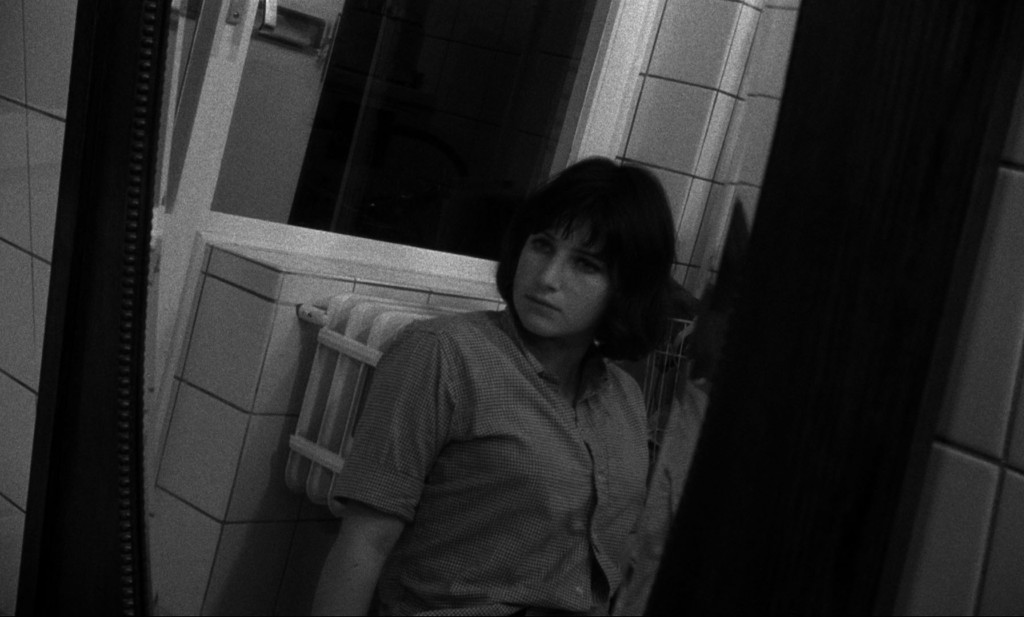

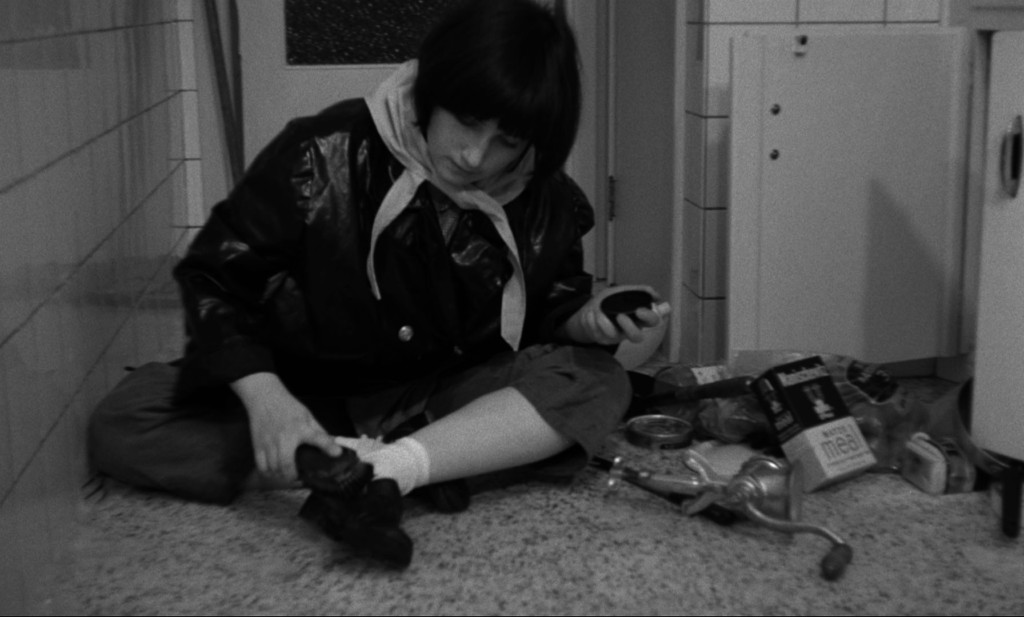
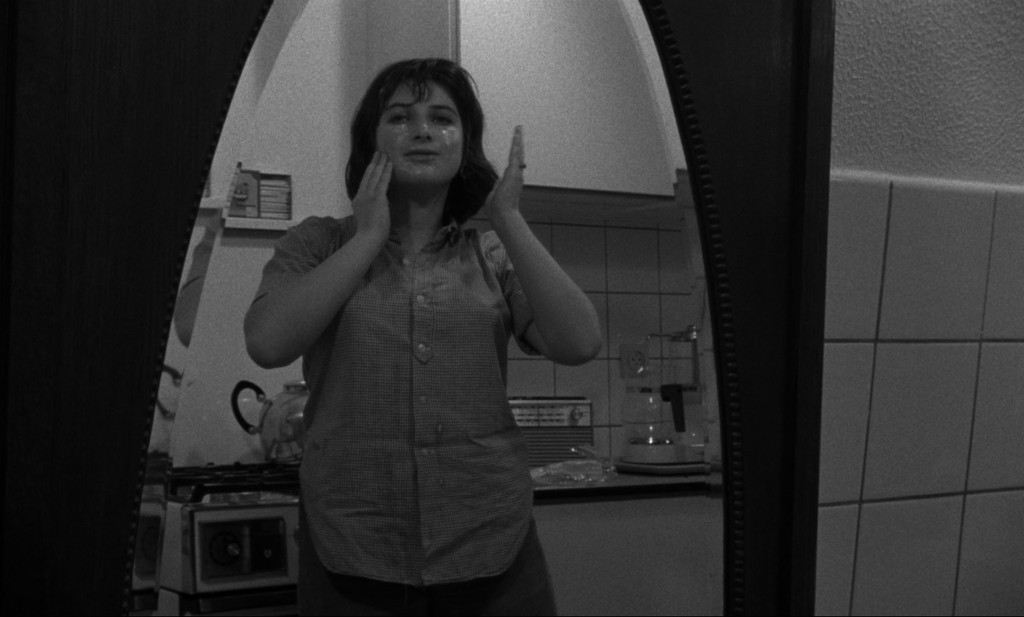
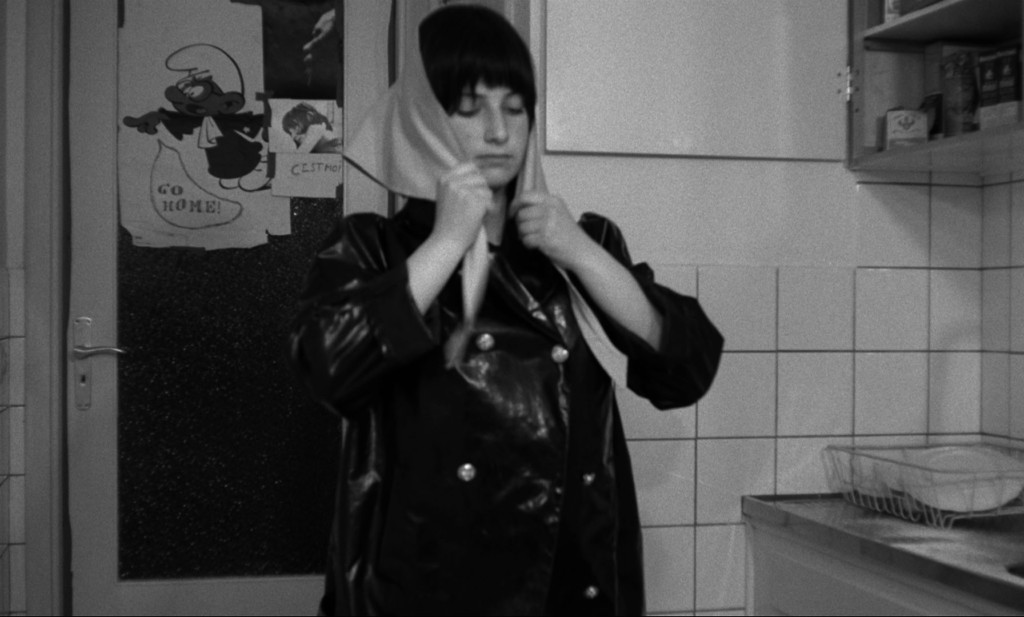
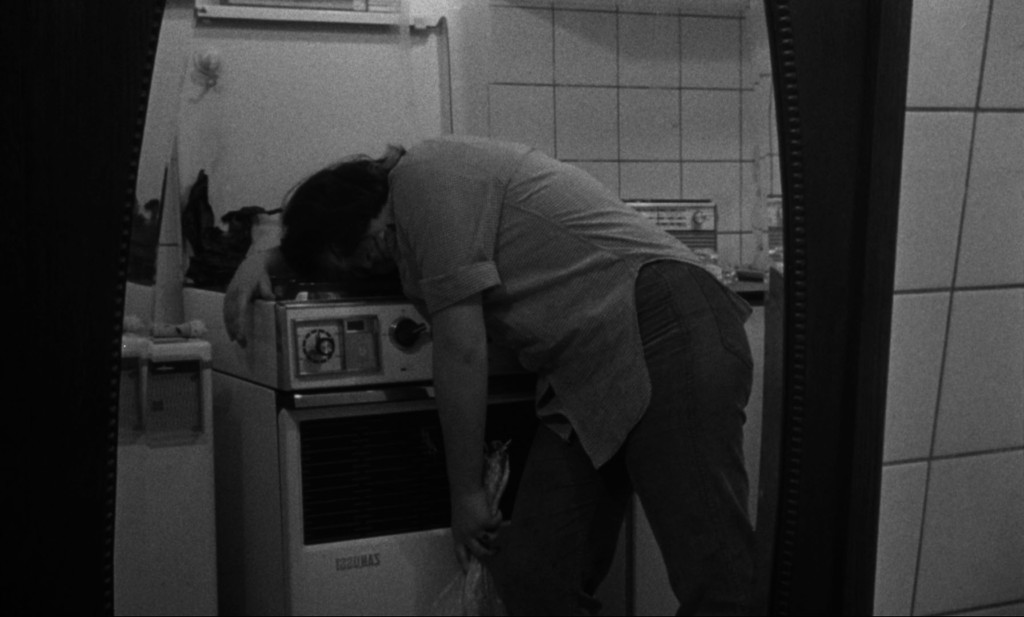
Saute ma ville (Blow Up My Town) is the first short film made by Chantal Akerman after leaving INSAS (Institut Supérieur des Arts du Spectacle) only three months after her admission, in 1968, at years old, in her family’s apartment on Avenue Mustaard Brussels. By that point, she had already made four short films as part of her entrance exam for INSAS. Akerman often cites Jean-Luc Godard as her inspiration to become a filmmaker, especially his 1965 Pierrot le Fou, that she saw at fifteen years old. In Saute ma ville, Chantal Akerman makes clear reference to Godard’s film, especially with her protagonist and the end of the movie. Both films embody a “tragicomic nihilism”, but in Akerman’s case, it is applied to the domestic sphere. It is no coincidence that the film was shot in 1968. Indeed, it was the year of Mai 68, the social and revolutionary movement that marked France and neighbouring countries. Inspired by those ideals, Akerman wanted to blow everything up, the world as we know it, hence the title and disruptive nature of the film. She also takes inspiration from famous silent film comic, Charlie Chaplin. Akerman’s film adopts a tragi-comic aspect, almost a reminder of Chaplin’s acting, giving the movie a very burlesque tone.
In an interview with Les Cahiers du Cinéma in 1977, Akerman explains how the movie came to life : “One day, I wanted to make a film that talked about me. It was Saute ma ville. I thus needed a camera, some film and we did the film, in one night. And then I edited it. (…) Then that movie stayed in the lab for two years: I didn’t have the money to get it out. Probably also because I didn’t really believe in that movie anymore. During those two years, I was in Paris (…) and when I came back to Brussels, I was asked to come and remove the film from the lab and pay. And since I still didn’t have the money, I went to see the lab director et asked him to watch it and tell me what he thought about it. He saw the film, it made him laugh, he really liked it. I took the opportunity to ask him if he didn’t know a way for me to sell the movie so I could pay him. He gave me three addresses, and one of them was the Flemish television. And there, was a guy who saw the film, liked it, and took it.” That “guy” from the Flemish television is Eric de Kuyper (1942-), a Belgian filmmaker, scriptwriter and writer. “(…) he tells you your film is really good and that he is going put it on tv on a show called L’Autre Cinéma (Die Andere film).
First called Kort Geknipt and in collaboration with Dirk Lauwaert, Die Andere film (then in collaboration with Emile Poppe) was launched in 1969 by De Kuyper on the BRT (Belgische Radio-en Televisieomroep, the Flemish public television, now known as the VRT, Vlaamse Radio-en Televisieomroeporganisatie), was a monthly program, until 1976, showing “alternative cinema”, focusing on experimental and niche films. It also aimed to introduce audiences to the current artistic trends, as well as social and political debates of the time. “I showed experimental films, underground movies, and other bizarre things.” (Eric De Kuyper, in “Temps mort” interview with Annie van den Oever). The TV show broadcasted films like Kockyn, een Kermiskroniek/Kockyn, the Chronicle of a Fair (Rein Bloem, 1966), Piknik v nedeljo/Picnic on Sunday (Karpo Aćimović Godina, 1968), Naisant (Stephen Dwoskin, 1964), Eika Katappa (Werner Schroeter, 1969), Sheet (Ian Breakwell and Mike Leggett, 1970), Hall (Peter Gidal, 1968/9), Mare’s Tail (David Larcher, 1969), A Day with Timmy Page (David and Iris Hoffman, 1969), Die Landschaftsgärtner (Kurt Gloor, 1969), War is Hell (Robert Nelson, 1968), Bloody River (Richard Besrodinoff, 1970), or Heute Nacht oder Nie/Tonight or Never (Daniel Schmid, 1973), among many others, notably Andy Warhol. And on October 18th 1970, Saute ma ville gets shown to the public for the first time ever.
“The movie gets showed and the next day, [André] Delvaux gives it a glowing review. When I heard that on the radio, I immediately called him. I met him and asked him, since he thought my movie was good, if he could help me make other movies.” Although, some collaborators of Chantal, as well as Eric de Kuyper himself contradict that version, saying that it was Delvaux, director and teacher at INSAS (Institut Supérieur des Arts du Spectacle) – the film school she attended for three months – that saw the film first and told Akerman to go see Eric de Kuyper. “One day my doorbell rang and I opened the door and saw a little girl [holding something]. It thought it was a cake and then she said “I bring you my film” : it was a big tin box with a 16 mm film [inside]” (Eric de Kuyper, taken from the translation by Katherine Schmelzer in Sight and Sound presents the auteurs series : Chantal Akerman, 2024). Since then, De Kuyper and Akerman became friends, as well as work collaborators, notably on the script for La Captive (2000), Demain on déménage (2003-2004), but also on a few uncompleted projects throughout her carrier. It is thanks to De Kuyper that Akerman really began her carrier as a filmmaker. After the broadcast, “the film was shown at festivals, and suddenly I became a filmmaker; I’d only ever made that one film, but even then, I was already a young filmmaker, as they say” (Chantal Akerman in “Le Frigidaire est vide. On peut le remplir” included in Autoportrait en cineaste, p. 49). The film indeed went on to be shown in various festivals, including the 17th edition of the International Short Film Festival Oberhausen in april-may 1971.
Despite Akerman considering it as its opposite, various researchers also frequently mention Saute ma ville in relation to Jeanne Dielman, 23 quai du Commerce, 1080 Bruxelles, which they consider as its the successor. They both share major themes that span Arkeman’s filmography, such as female protagonists in oppressive domestic environments, chores, and death. They also both remind of Stanley Cavell’s concept, the “new discovery of the violence of the ordinary”. Janet Bergstorm also notes that the end of Saute my ville and the beginning of Jeanne Dielman are connected by sound. Indeed, Saute my ville ends with the sound of the gas whistling from the stove, where Jeanne Dielman begins with that same sound from the gas stove being turned on by Jeanne. Laura Mulvey probably sums up best what the film is about and Akerman’s intentions: “I think you see in Saute ma ville the spirit that made it possible to do Jeanne Dielman. For me, one of the things that give Chantal Akerman films something very special is a kind of craziness. Of course, we experience this in Saute ma ville which is a completely crazy film. It’s like kind of a surrealist joke” (Laura Mulvey in Chantal Akerman – altijd onderweg by Pieter Verbiest & Katherine Schmelzer, 2024).
Available on
Bibliography
AUBENAS, J., Hommage à Chantal Akerman, Communauté française de Belgique, Brussels, 1995.
BAKKERS, G., “De Andere Film en Kort Geknipt, of hoe de marginale film zijn intrede doet in de Vlaamse huiskamer”, De Witte Raaf 191, january-feburary 2018, [Online].
BERGSTORM, J., “Invented memories”, in FORSTER, G.A., Identity and Memory : The films of Chantal Akerman, Flicks Books, Trowbridge, 1999, pp. 94-116.
BLOCK, M., « Blow Up My Town”, in BLOCK, M., SZANIAWSKI, J., Directory of World Cinema : Belgium, Intellect, Bristol, 2013, pp. 77-79.
BRENEZ N., “Chantal Akerman : The Pajama Interview”, LOLA journal 2, 2011, [Online].
DUBROUX, D., GIRAUD, T., SKORECKI, L., “Entretien avec Chantal Akerman », Les Cahiers du Cinéma n°278, july 1977, pp. 34-42.
FERNANDEZ FERRER, N. « About Saute ma ville (1968), Chantal Akerman’s first film », Senses of Cinema 77, decembre 2015.
FRODON, J.-M., “Saute ma ville », in AKERMAN, C., PAQUOT, C., Chantal Akerman -Autoportrait en cinéaste, Cahiers du Cinéma – Centre Pompidou, Paris, 2004, p. 172.
LOAYAZA, B., « Chantal Akerman, 1968-1978 : The Weight of Being”, Criterion, 23 january 2024, [Online].
SCHMID, M., Chantal Akerman, Manchester University Press, Manchester, 2010.
SIGHT AND SOUND, “I bring you my film”, Sight and Sound presents the auteurs series : Chantal Akerman, London, 2024, pp. 18-19.
VAN DEN OEVER, A., DE KUYPER, E., “Temps mort : Speaking about Chantal Akerman (1950-2015)”, Necsus, 27 november 2015 [Online].
VERBIEST, P., & Katherine Schmelzer Chantal Akerman – altijd onderweg, Belgium, 2024, 52 min.